
While you can basically turn any transparent and waterproof container into a mospot, there are some things to look out for when picking a suitable base for your mospot project. The container you choose is the one that first catches the eye and will determine the overall layout of your mospot: tall and slim, low and flat, square or round, closed or open, etc.
Choose glass
If you are looking to purchase a new container for a mospot, you will soon find that acrylic or perspex containers are a lot cheaper than full glass. However, keep in mind that acrylic can easily show problems such as discolouration, scratches and distortion.
What can be an advantage with acrylic is that it is easier to work with if you would like to drill through the container to provide lighting or a pump, for example – something that can also be done with glass, but is a lot more difficult and risky.
Glass is generally preferred because it gives better colour representation, minimal discolouration or distortion on understanding, is more temperature resistant, and is guaranteed to be completely chemically neutral.
Where to find
You can of course buy new glass, think vases, candy jars, shop displays, spherical aquariums, etc. These are all good choices and are easy to find in mainstream shops such as IKEA, YGO, and other interior design and flower shops each time.
Moss pots, however, are an ideal project to make use of second-hand glass. Second-hand chains such as Opnieuw & Co often have a huge range of vases, jars and other glass containers for 1/10th or less of the price of new glass. Almost all moss pots on this site are made with second-hand glass purchased for €2 – €10.
Searching among second-hand glass sometimes also gives you choices between interesting container options you might not have otherwise considered.
Not every piece of glass will be available with a matching lid; for this, look at things like cheese glasses, glass coasters, jar lids, etc. of similar size. You can often find matching improvised lids with these kinds of pieces.
What to look out for
When choosing your glassware – new or second-hand – it is best to pay attention to a number of things
Open or closed?
An open moss pot is less likely to get mouldy, but the moss will dry out faster, so it needs to be regularly misted (and then the glass polished). However, open moss pots are very attractive to mourning flies, which like to lay their eggs in moist soil. You can use stenema nematodes – these are added to the soil and feed on the eggs of mourning flies and some other parasites.
A closed moss pot requires less maintenance and should be a closed ecosystem and vivarium, where the only maintenance is possibly trimming plants. Due to the moist environment in the pot, the risk of mould growth is high (say: guaranteed), but this can be kept in check by clean-up creatures such as springtails and isopods.
For a closed mospot, choose glassware with appropriate lids. Although cork stoppers are widely used, a glass lid allows better light to enter your pot, and will not go mouldy. Often, you can also use an improvised lid – think glass bowls, serving trays, coasters, cloches, etc;
Viewing angle
When choosing your glassware, keep in mind what viewing angle you have in mind. Do you want a mospot that stands on a cabinet at eye level, or do you prefer one that will stand at hip height? Are you going to look at it mainly from the side, from the top? Against a back wall, or centrally and therefore fully viewable all around?
The choice of your desired viewing angle will influence other choices later on: how big your pot is, its shape, general layout, quality requirements of the glass, lid choice, etc.
Defects
Even new glass can have minor manufacturing defects. These need not be a show-stopper, but some are disturbing. Think of “bands” in cylinder shapes, disturbing views from the side. You see this especially in cheaper glass vases, and is very simple to check by holding a ruler, yardstick or similar in the jar and seeing if everything is nicely readable from the desired viewing angle.
Also note any air bubbles or other impurities in the glass; if these occur mainly on one side, this need not be a problem if your pot will be a front view and you can therefore use that side as the “build side”.
Plan for the entrance
The classic “dame-jeane” is known as a plant terrarium or closed ecosystem, and these bottle shapes are tempting to work with, but I personally advise against them myself as first project(s) for a number of reasons.
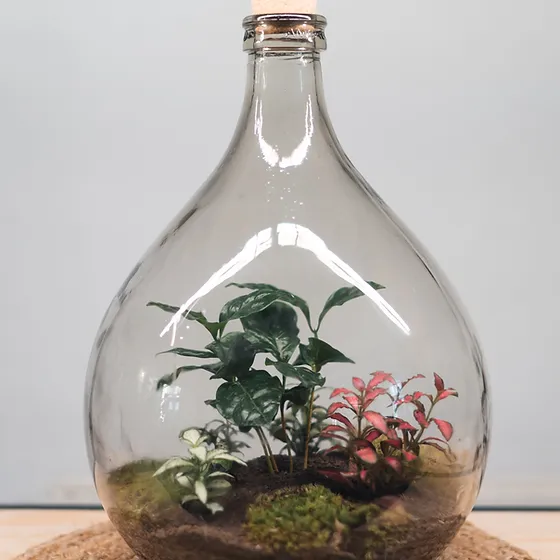
- A narrow bottle neck is tricky to work with. Obviously not insurmountable, but especially as a first project it can be extremely frustrating, especially if you don’t have special tools like long tweezers.
- Plant selection is limited to small cuttings that fit through the bottle neck, and your hardscape choices are also limited by size. Especially for plant growth, this means it can take a long time for such a terrarium to flourish.
- Any maintenance such as cleaning the glass inside is similarly difficult.
- Because of the thickness of the glass, you can regularly see making defects – for large bottles with large plants this is not really a problem, but for a mospot where you like to see small details, this can be disturbing. Really clear lady-jeane or fermentation bottles can be found, but then these are priced accordingly.
Unless you are really fond of that shape, for your first mospot it is best to choose a slightly easier container
Watertightness
It seems obvious, but make sure your container is watertight – or can easily be made watertight. Beautiful geometric glass cubes or other shapes often used for dried flowers or displays can be perfect for a mospot, but are often not watertight by default.
You can easily solve this in itself with a line of pure silicone in all seams, but be aware that this can also be tricky for certain shapes!