
Moss pots may be low-maintenance, but completely maintenance-free is not possible. Ultimately, the idea is to balance an ecosystem by optimising light, temperature, humidity and air within your biome.
In practice, this mainly comes down to choosing the right location, and occasional minimal maintenance.
Air

All plants need air, as do mosses. Even with a closed mossarium, try opening it up for an hour or two every day. Aerating your moss/terrarium replaces stale gases and allows fresh air to flow into the flora, which avoids mould growth.
Although covered moss pots can still survive, most moss species grow faster and healthier with higher airflow and regular fresh air.
Just keep in mind that regular air changes also mean that the pot will dry out faster!
Light

Like all other plants in their family, mosses use light as a food source for photosynthesis, with one big “but”: never direct sunlight!
For normal mossariums up to about 4L, any good desk lamp with a bright LED bulb burning 10-12 hours a day will work. For larger mossariums, consider 6500K grow lights. A spot by the window with indirect sunlight can also work well for a basic mossarium, but make sure you turn it regularly.
Warm soft light generally provides the best “exhibition” of the moss pot. If your moss pot gets too much or too strong light, you will notice this over time by the moss’s paler white-green colour, rather than its healthy deep green.
Temperature
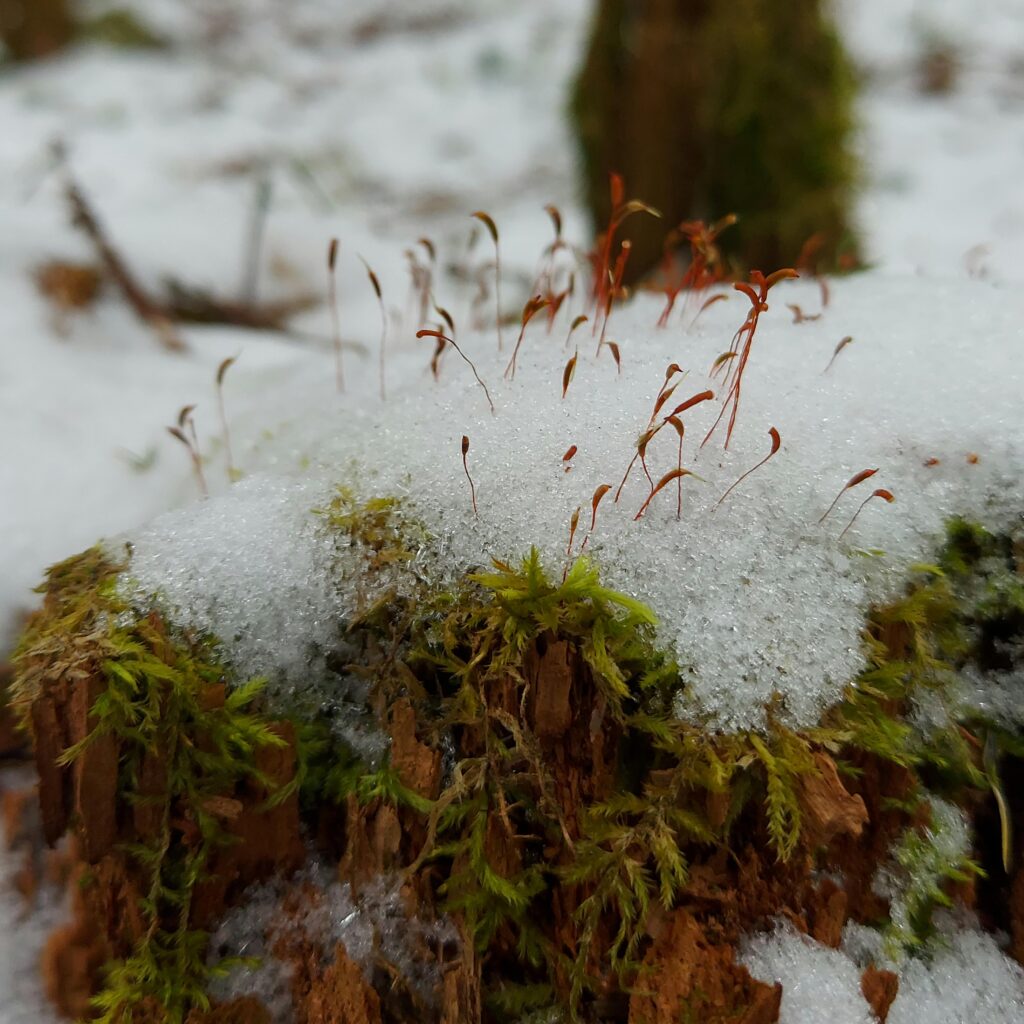
Mosses stop photosynthesising at temperatures below 15°c or above 40°c. An average temperature of 18 – 25°c is generally good for mossariums, but exceptions exist, so research your unique species if necessary.
Circadian fluctuations in temperature are to be expected, of course, but not wild fluctuations. Mossariums that are too warm are more likely to have fungal outbreaks.
Never put your moss pot in direct sunlight! Not only is this too strong light for most mosses, in a sealed glass moss pot it will quickly cause extreme temperatures!
Humidity

Humidity is important for moss growth, but like all plants, you can still overwater. Too much humidity will turn your moss brown and eventually kill it.
For closed mossariums, give one good misting and then keep an eye on the humidity: if the glass fogs up slightly around sunrise, the humidity is good. If it never fogs up, mist again. If it always fogs up, leave the pot open for a while to let water evaporate.
Since mosses do not contain roots and absorb water via surface, it is always better to mist or use a plant sprayer rather than a watering can. If you have additional plants in the mossarium, however, it is advisable to suck away any droplets that form on leaves with a sprayer, or cloth them up – these can cause brown stains.
Do not use tap water when watering – it generally contains too high a proportion of lime, and your mosses will form lime crystals and white spots. Preferably use rainwater, otherwise distilled water can also be used.
Flora
If your mossarium also contains larger plants, you can prune them or remove any leaf fall. In principle, this is not necessary, but seasonal pruning can be useful for aesthetic reasons.
For many plants that are compatible in mossariums, you can very easily make cuttings from your prunings by simply removing the lower leaves and putting the cutting in water.
Fauna

Your moss pot “naturally” contains a number of clean-up animals like springtails – small white insects that take care of cleaning up fungi and decaying material such as leaf fall and dead moss leaves, and the population is therefore self-maintaing.
Other fauna you regularly see are so-called mourning flies – similar to fruit flies in appearance and size. Infamous to many a houseplant enthusiast, these lay their eggs in moist soil and create clouds of black flies if you disturb the plant and cause voracious damage to the plant.
There are biological control agents such as stenema nematodes that are natural enemies of the mourning fly and will parasitise parasitise and kill the larvae – which cause most of the actual damage.
These flies mainly occur in mospots that also contain other plants and thus potting soil is used. In “pure” mospots where only spaghnum and cocos are used this risk is much lower.
Fungus and mould

Not surprisingly, an enclosed, damp room with stagnant air is also an ideal breeding ground for fungi.
Especially with sealed mospots, mould threads may form, or even complete fungi. This is completely natural and poses no problem – a mospot is a living system and will evolve over time. The fungi do not affect healthy plants, and the springtails in the mospot will eventually clean it up.
For prevention, you can water with a light solution of chamomile tea and water – the sulphur compounds in the tea have a mild anti-fungal effect.
If there is really a lot of mould in the pot, or permanent colonies are forming that you still want to remove, you can use a light solution of water and vinegar to dab the affected areas with cotton swabs.